How we source

Media buying

The Zappian website 21 prints

The story behind each page.

The site is drawn as Japanese woodblock prints: indigo ink on cream paper, with orange saved for the sun and the main action. Here is what each page depicts, and the story it wants you to see.

The parent print

The homepage and its other face.

The homepage is the parent print. Every other page takes its paper, inks, seals and river from it. The agent view is the same site, written out for AI readers.

Print 01 of 21

Homepage

The print
One day in one country, first light to night
The story in one sentence
Every part of Zappian is a place on one river, and a visitor travels down it through a single day, from the lenders' harbour in the morning to the post station at night.
Open the page: Homepage
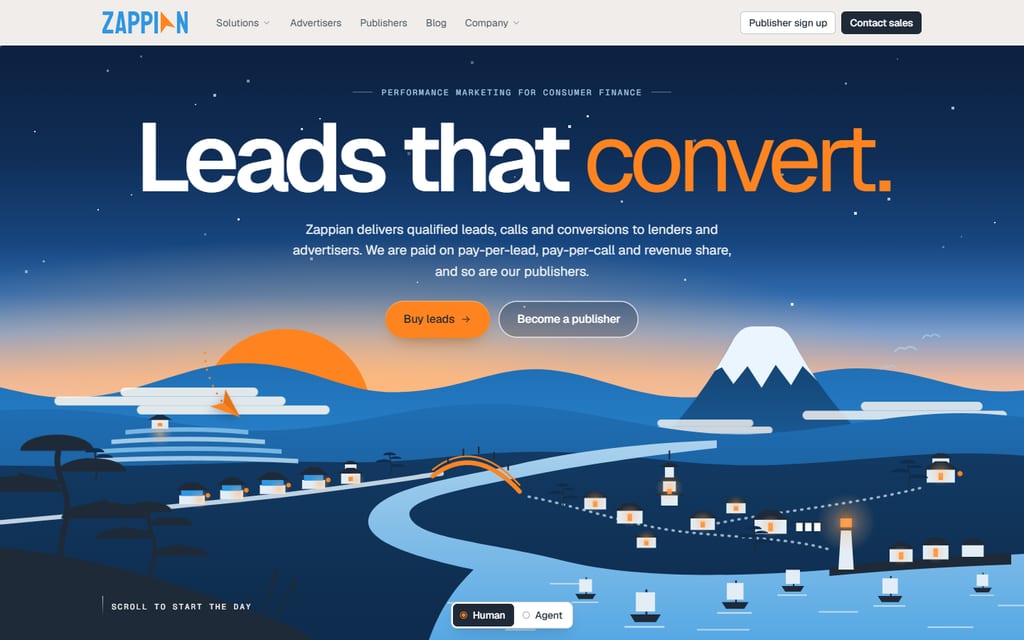
The top of the homepage: the headline “Leads that convert.” in a night sky over a whole country at first light, with a river, a bridge, a town, a harbour and a snow-capped mountain, and the sun just rising.
Opening view

What the picture is

The homepage is one journey through one country, drawn in the style of Japanese woodblock "aizuri-e" prints that are made almost entirely in blue. A river runs from a snow-capped mountain to the sea. Along it lie a harbour, a market road, a long orange bridge, a fleet of boats, a terraced hillside, a town and a post station. Each place is a full-screen picture, and each stands for one part of the site. The sky is the clock. It opens as an indigo night with stars, turns peach at first light, then blue through the morning, gold in the afternoon and orange at sunset, and it ends as a navy night lit by lanterns. A small orange paper dart, the arrow from the Zappian logo, flies the whole way. It stands for a lead.

The moment

It happens as you scroll, in three ways. First, the day turns: the sky behind each picture moves from night to dawn to noon to dusk while the picture itself holds still. Second, each place answers when you arrive: boats sail in, a traveller walks on, scrolls unroll, and the dart swings across the screen along a dotted path. Third, each place answers when you pick: a boat comes in to the pier, a traveller walks to a door, a lamp lights, water runs. The signs you pick are real controls. They work with a mouse, a finger or the arrow keys, and the card beside the picture then says in one sentence what that page is and gives the way in.

Why this picture

The homepage has to hold the whole site: two audiences, five lead programs, two offers, six channels, three ways to pay, a company and a form. A list of those is an index. A country you travel through lets each one be a place with its own picture, and the day gives them an order and an ending. The earlier homepage told one lead's road in six framed prints on cream paper. This one keeps its river, its bridge and its dart, and puts the visitor inside the pictures.

The shared visual language

Every other page descends from this one.

  • The river and the two banks: supply on one side, demand on the other, with a bridge between.
  • The seal: a small orange stamp with a kanji numeral opens each place, like the mark a printmaker presses on a finished sheet. It stands for a human who stands behind the work.
  • The inks: tints of one blue, navy for line, and a plain modern typeface for headings. Orange is kept for the sun, lamplight, the bridge, the dart and the seals.
  • The sky as the clock: indigo with white words at night, pale blue and gold with navy words by day. An orange word appears only on indigo or navy.
  • The mist bands (kasumi) divide one place from the next, as clouds divide scenes in a scroll painting.
  • The story rail: on wide screens a column of seals on the left edge shows which place you are in and jumps to any other. It is hidden on narrower screens.

Details worth noticing

  • The mountain in the first picture is the same mountain that stands under the moon in the last one.
  • The road ends at the bridge in the noon picture, and the next picture is that bridge.
  • The dart is the only orange thing that travels, so the eye follows it. At the end it has landed on the letter box of the post station.
  • Each walking figure's legs are separate pieces that swing at the hip, so a walk costs the browser almost nothing.
  • On a phone each place shows its words first, then its picture as a wide window. The signs become a row you can swipe, the picture itself can be swiped to the next place, and it slides to the door you pick.
  • On a tablet held upright the words and the card stand side by side above the picture, and the signs sit in a row beneath it. Held sideways, a tablet shows each place whole and held, like a desktop: the sheet is fitted to the width of the screen, with more sky above it for the words.
  • On a phone the dart shows only while it is over a picture, so it never lies across the words. Sky and passers-by hold still there, and boats and walkers arrive once when a picture comes into view.
  • With reduced motion nothing is pinned and nothing moves by itself. Every picture is whole and still, and picking a sign changes the picture at once.
  • The hero is drawn into the page so it shows at once. Every picture below it is a set of image files that load as you come near.
Read it section by section8 parts
Homepage, section by section
SectionWhat you seeWhat it means
Hero, first light: "Leads that convert."The whole country at once under a night sky, with lamps lit in every window and the sun just showing behind the hills. On scrolling, the sun climbs, the lamps go out, and each place gets a name you can jump toThe promise, and a map of everything the page will visit
Morning, the lenders' harbour (seal 一): "Buy leads that match your buy box."A lighthouse, storehouses and a pier. Five boats lie at anchor, one for each lead program. Pick a boat and it comes in to the pierLenders and advertisers, and the five lead programs: personal loan, payday, tax debt relief, merchant cash advance and debt consolidation
Noon, the publishers' road (二): "Monetise your traffic on your terms."An inn, a fan shop, a lantern stall and a roofed gate, with the bridge beyond. Pick a stop and a traveller with a bundle walks to itPublishers: the program, the two offers they can promote, and the sign-up
Afternoon, the bridge (三): "One bridge joins two shores."A long orange trestle bridge with porters crossing, and three scrolls hung in the sky above itA lead crosses when it fits the buyer's criteria. The scrolls are the three payout models: per lead, per call and revenue share
Golden hour, the fleet (四): "Six channels bring them in."Six boats on a golden sea, each with a net on the water, and a ledger that names themThe six channels: email, SMS, push, content, social and media buying
Dusk, the town: "We count what a buyer can use."Six lit doors on one street under a pale moon: a house, a festival stall, an orange gate, a print shop, a notice board and a line of drying prints. Pick a door and a lamplighter walks to itThe company: about us, culture, careers, the blog, the news room and the story behind the site.
Night: "Questions partners ask first."Questions that open and close, under the starsAnswers at the gate.
Night, the post station: "Let's make progress happen together."A letter to fill in. Below it, an inn with its lantern lit, a road of small lamps climbing to a far pass, and the dart landed on the letter boxThe way to send word, and the end of the day

Print 02 of 21

Agent view

The print
The same site, drawn in text
The story in one sentence
Every page has a twin written for AI readers, plain Markdown on a dark screen, so a machine and a person are each shown the version made for them.
Open the page: Agent view
The drawing at the top of the site brief: a sun, a mountain, waves and the dart, typed in characters on a dark navy screen.
The site brief

What the picture is

This is not one print but the back of every print. Where the human site is cream paper and blue ink, the agent view is night: a dark navy screen with light text, the site's navy taken darker. Each page appears as its raw Markdown file, with the symbols (hashes, brackets, table bars) shown faintly. The one drawing is on the site brief, the agent view of the homepage. It redraws the homepage's first print, the sun, the mountain, the waves and the dart, using typed characters in a grid. The dart is a greater-than sign with an equals-sign tail.

The moment

When you press Agent on a human page, the new page wipes in from the top, as if a file were being read out line by line. The switch dot lights orange for the face you are on. The cursor in the request panel blinks. The quick jump opens with Ctrl or Command and K. It is a searchable list of this page's sections and the whole site's pages. The wipe plays only when you change face, not between two agent pages.

Why this picture

More visitors now arrive as AI assistants, and they read cluttered pages badly. A twin written in clean Markdown, with the human page named as the canonical source, gives them an accurate account of what Zappian says about itself. It also shows people what an assistant sees. The dark screen and typed print make the change of audience obvious without a word of explanation.

Details worth noticing

  • The dock is the same switch on both faces, at the bottom centre. The current face is plain text, and the other is a link. It works without scripts and with the keyboard.
  • Each page can also be fetched as a plain Markdown file or a JSON file.
  • On a phone the line numbers and path label are hidden and the section bands run edge to edge.
  • Reduced motion turns off the wipe, the cursor blink and the transitions.
Read it section by section6 parts
Agent view, section by section
SectionWhat you seeWhat it means
Top barThe logo on a small cream tag, the page path, the kind of page, and a button back to the human pageYou are in the agent face, and one click takes you out
Request panelA line like a command typing, with a blinking orange cursor, and a response line giving the file type, size, line count and an estimated token countThis is what a machine receives when it asks for the page
ActionsThree buttons: copy the Markdown, open the raw Markdown file, open the raw JSON fileThe same content in three forms, ready to take away
The page itselfThe Markdown, set in a code-like face, with real headings, lists, tables and linksThe text a reader gets is the text of the file, character for character
Footer"End of file", then links to the site brief, the site's index for AI readers and the human pageMarks where the file stops and offers the next step
The dockAt the bottom centre, a Human / Agent switch, and a quick-jump key hintFlip between faces from the same spot on every page

Two banks

Pages for partners.

The two banks of the river, and the ways to reach us.

Print 03 of 21

Advertisers

The print
A lender's harbour, boats docking
The story in one sentence
The visitor, a lender, should feel that the leads come to a berth that was made to their size, and that they set how many boats arrive.
Open the page: Advertisers
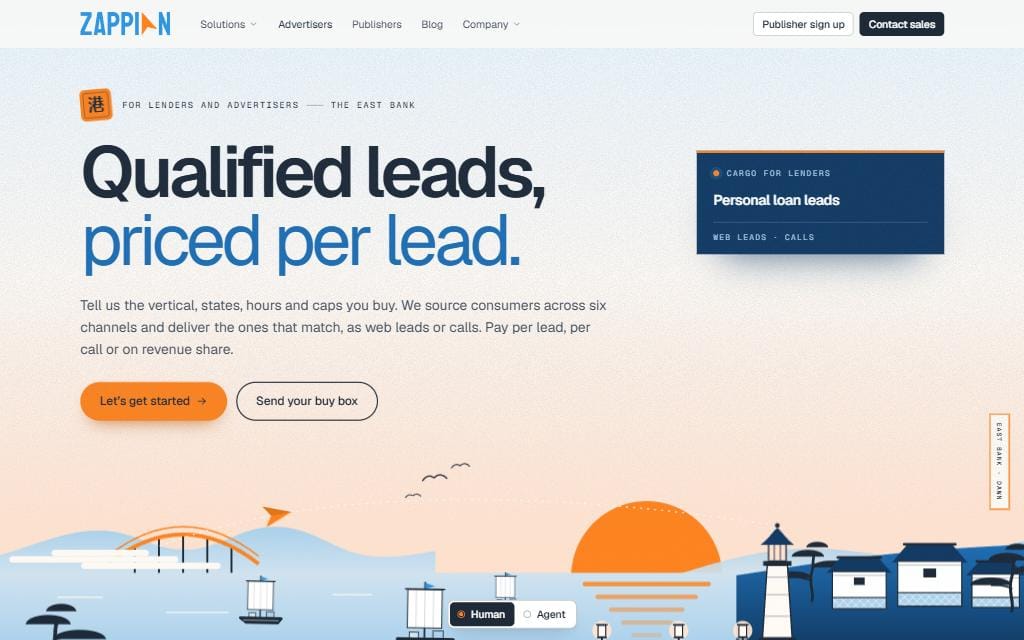
The top of the advertisers page: the headline “Qualified leads, priced per lead.” above a harbour at dawn with sailing boats, a lighthouse and a far orange bridge.
Opening view

What the picture is

This is the east bank, the far end of the homepage's bridge. The scenes show a blue sea, a pier, white storehouses, a stone lighthouse and small sailing boats. Each boat stands for one part of what a lender buys: the traffic, the verticals, the states and the way they pay. The orange paper dart is a lead flying in from the bridge. Orange is kept for the sun, the dart, the berth seals and the lender's own mark on the tide gauge.

The moment

On a wide screen, the harbour print stays in place while the visitor scrolls. The boats sail in from the sea one by one, moor, drop their sails and light a lantern. The paper dart flies ahead of each boat to its berth, and the list beside the print marks each boat as docked. It says that the buy is built piece by piece around the lender.

Why this picture

The lender is the party who receives. A harbour is a place built to receive, with a berth for each arrival. The boats make the buy box concrete, since each part of the order is something you can see arrive.

Details worth noticing

  • The hero cargo board turns every few seconds and stops when the tab is hidden or motion is reduced. A screen reader gets the full list in a plain sentence.
  • Wave patterns, the lattice on the storehouse walls and the stepped mist bands are traditional print shapes.
  • The tide band is dark indigo with a mist edge, so it reads as the page's low tide.
  • On phones the boats are already moored. They sail in once when the print scrolls into view. The card rows become swipeable strips and the letter follows the story.
  • With reduced motion, headings appear in place and the boats do not bob.
Read it section by section6 parts
Advertisers, section by section
SectionWhat you seeWhat it means
Hero: "Qualified leads, priced per lead."A dawn harbour with boats, a lighthouse and a far orange bridge. A dart flies from the bridge to the lighthouse. A small board turns through five kinds of cargo, such as loan and debt leads.Leads cross from the publishers' bank to the lender, as web leads or calls.
Your appetite: "It is not how many leads we can send. It is how big your appetite is."A dark indigo band with a tide gauge in a round window. The water rises to an orange mark and a boat rises with it.The lender sets the daily cap. Volume follows what they ask for.
Arrivals: "What docks at your berth."A sticky harbour print beside a numbered list. Six boats, marked with the numerals one to six, come in and moor.Each boat is one part of the buy: traffic, verticals, states, pay per lead, pay per call, revenue share.
The notice board: "Recent insights from our blog."A sideways row of three cards, each with a small print: rising waves, a page with a boat, pennants on a jetty.Reading material kept beside the harbour office.
Get in touch: "Send us your buy box."A short note, a checklist of what to include, an email line and social links. The enquiry letter sits beside it on wide screens.A buy box is the lender's order: vertical, states, caps, payout model.
Your berth is ready.The harbour at dusk. Boats are moored, lanterns are lit, the sun sets behind hills.The work is ready to start when the lender is.

Print 04 of 21

Publishers

The print
A market road to the bridge
The story in one sentence
The visitor, a publisher, should see a road they walk with their own traffic, with clear stops along it, ending at the bridge where buyers wait.
Open the page: Publishers
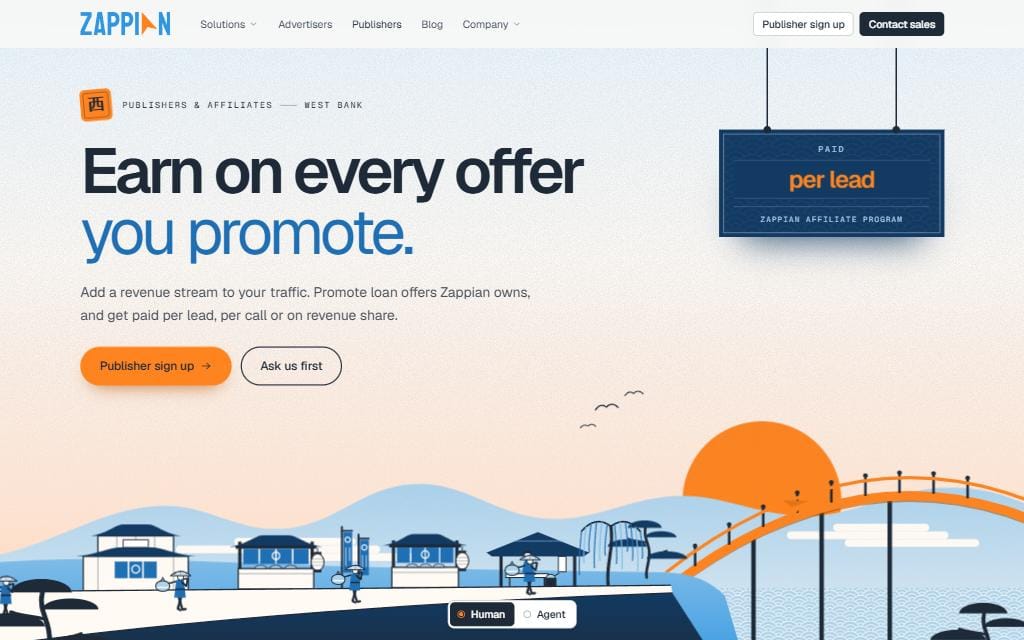
The top of the publishers page: the headline “Earn on every offer you promote.” above a market road of stalls and travellers that leads to an orange bridge.
Opening view

What the picture is

This is the west bank, the start of the homepage's bridge. A traveller in a sedge hat carries a bundle on a pole along a road lined with stalls, inns, milestones and stone lanterns. The bundle is the publisher's traffic. The orange bridge waits at the end of the road, and the orange paper dart, a lead, flies ahead. The publisher earns when what they carry crosses to a lender.

The moment

On a wide screen the road section pins in place while scrolling. The road slides sideways from one station to the next. The far hills move more slowly, the sun climbs, and the traveller walks on the spot. They turn round if the visitor scrolls back. A small map counts the stations passed. It says that each reason is a stop on a journey, not an item in a list.

Why this picture

Publishers carry traffic from place to place for a living. A road with stops fits their work, and the bridge at the end shows where the traffic goes and who pays for it. The travel pass makes joining feel like getting a permit, which is how the programme works: a person reviews the sign up.

Details worth noticing

  • The orange is kept for the sun, the bridge and the dart. The rest is blue on cream.
  • The shop sign is a turning three-sided prism that repeats the three payout models. It is decoration, so screen readers skip it.
  • On phones and short screens the road is a plain vertical road. A line inks down it as you scroll, on browsers that support scroll timelines.
  • At the close, the traveller walks onto the bridge as the section scrolls into view, on browsers with scroll timelines.
  • With reduced motion, the sign stops turning and the road does not slide.
Read it section by section8 parts
Publishers, section by section
SectionWhat you seeWhat it means
Hero: "Earn on every offer you promote."A sunrise market road with travellers heading for an orange bridge. A hanging shop sign turns through "per lead", "per call", "on rev share".The publisher chooses how they are paid.
The Zappian Affiliate Program (ZAP)A wooden travel pass on a cord, with four rows: who it is for, the offers, how you are paid, and how you enter.The programme in one object, small enough to carry.
Why publishers take this road.A road that slides sideways. Four stations stand on it: a stall, a milestone, an inn and a teahouse. A small map and a station count sit above.Each station is one reason to send traffic here: choose your payout, we earn the same way, judged on what converts, a person sets you up.
Two stalls, offers we own.Two market stalls with an eave, noren (cloth door curtains) and a lantern. One is personal loans, one is payday loans.These are the offers the publisher can promote.
Three stamps to your first commission.Three round post-station stamps: an open gate, a road with a hat, the sun over a bridge.Join, send traffic, earn.
Questions before you sign up.A checkpoint gate over a list of questions. The first is open.The usual questions, answered before a person has to ask.
Let's make progress happen together.A letter-style form with a short checklist. A link offers sign up instead.The publisher can ask first before applying.
Ready when your traffic is.The foot of the bridge at dusk. The road ends at a lit lantern and the traveller steps onto the bridge under a setting sun.The crossing: sign up, and the traffic goes over.

Print 05 of 21

Media buying

The print
A fishing fleet casting four nets
The story in one sentence
The visitor should see that we go out to many kinds of water, cast one net in each, and bring everything back to one landing: qualified leads.
Open the page: Media buying
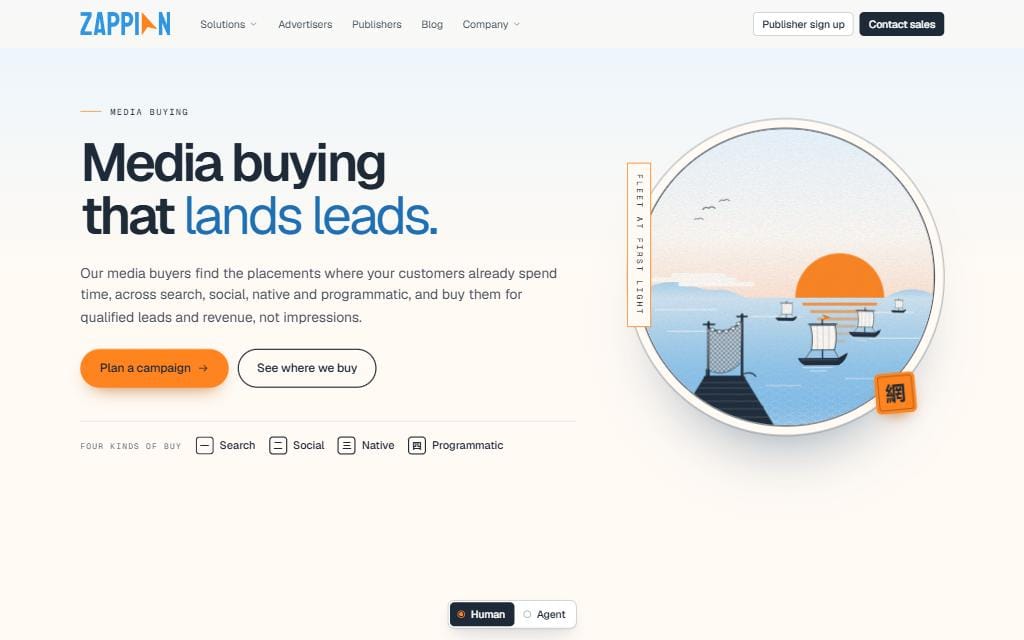
The top of the media buying page: the headline “Media buying that lands leads.” beside a round window onto a harbour at first light, with boats under sail.
Opening view

What the picture is

A fleet of wasen, which are low Japanese wooden boats with one square sail, leaves a harbour at first light. Each boat spreads a round net on the water. Mesh, floats, jetties and layered sea are all drawn in the same blue-on-cream print style as the homepage. The boats stand for our media buyers. Each net is one kind of buy: search, social, native and programmatic. What comes back in the nets is the lead. The orange sun and the paper dart are the only orange.

The moment

On a wide screen the four-waters picture stays under the header while the visitor scrolls. It plays one fishing trip. Boats leave the landing one after another and spread out to four waters. Each casts a net, and the matching text column lights up with a rule and a seal. Then the nets are drawn in, the boats return, and the dart lands on a label reading "One landing". It says that every channel is measured by the same result.

Why this picture

Media buying is going out to where the fish are, and each channel behaves like a different water. A fleet makes four channels read as one operation. The single landing keeps the point that we are judged on qualified leads, not reach.

Details worth noticing

  • Wave patterns and stepped mist bands are borrowed from print and scroll painting.
  • Separate sea layers slide at different speeds, so the far water barely moves and the near water moves most.
  • The words state plainly what we buy. The fishing story lives only in the pictures, and the pictures are hidden from screen readers.
  • On phones and tablets the same trip is one upright, finished print with boats out and nets open. Nothing scrubs.
  • With reduced motion, the boats do not bob, the sun does not rise and the rope knots are already tied.
Read it section by section9 parts
Media buying, section by section
SectionWhat you seeWhat it means
Hero: "Media buying that lands leads."The harbour at first light seen through a round window. Its layers shift a little as you scroll or move the mouse. A short list names the four kinds of buy.We buy placements for leads and revenue, not for impressions.
Our media buying strategy: "Four steps, tied in the same order."A rope with four knots: plan, negotiate, coordinate, review.Every campaign follows the same four steps.
Offers: "Right offers, right results."Two panels with small prints. One boat with a dart on the mast is Zappian's own offers. Two boats towing one net are partner offers.Two ways in: promote offers we own, or plan a buy with partners.
Loan verticals: "Media buys for five loan verticals."A net made of cells, one per vertical, plus a last cell for "another vertical?".The kinds of lending we buy for.
Media solutions: "Four waters, one landing."A sea in layers with a fleet. Four columns of text sit below, one per kind of buy, each with a numeral seal.Search, social, native and programmatic, each with its own boat and net.
Five ways we promote your ads.A ledger of five small gear drawings: pay per click, native, display, programmatic, push.Different water needs different gear.
What partners ask before they buy.A list of questions, the first open.Plain answers before the enquiry.
Buy high-impact space. Bring the leads home.Dusk. The fleet is tied up at a pier and the dart comes home.The trip ends with leads delivered.
Let's make progress happen together.A letter-style form with a checklist of what to include.Where the visitor starts a campaign.

Print 06 of 21

Contact us

The print
A post station and a paper crane
The story in one sentence
The visitor should feel that writing to us is like posting a letter at a station where someone will read it and send it to the right desk.
Open the page: Contact us
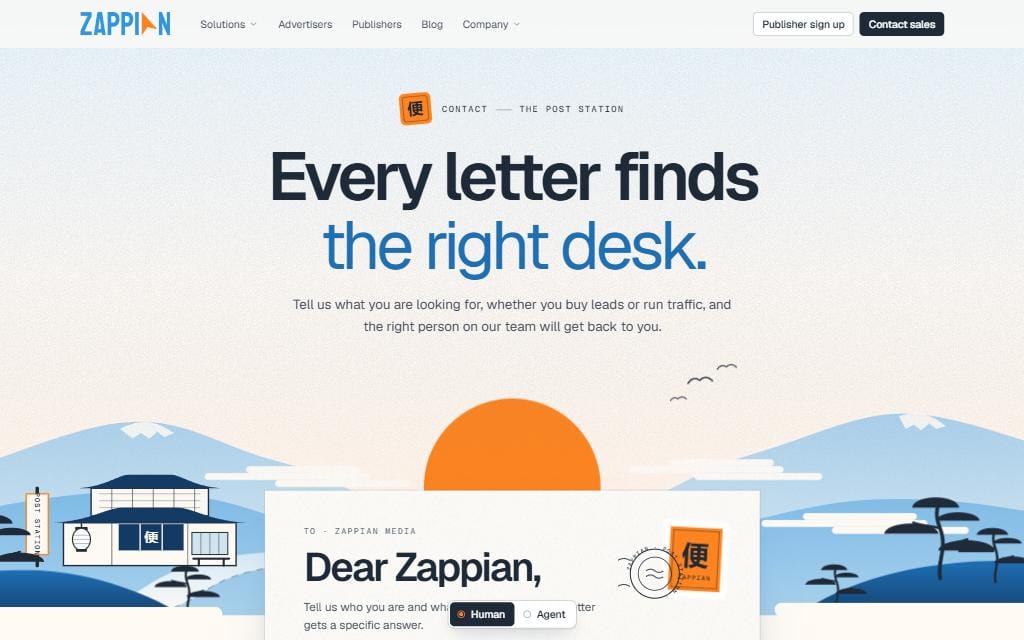
The top of the contact page: the headline “Every letter finds the right desk.” above a sunrise over blue mountains, an inn on the road and the top of the letter form.
Opening view

What the picture is

A post station on a mountain road. A wooden inn with an indigo noren (cloth door curtain) and a paper lantern stands by the road, with a second station far up the pass. The enquiry form is drawn as a sheet of writing paper with a postage stamp. Beside it an orange paper crane stands on a writing box. On this page the crane is the messenger in place of the homepage's dart. The letter is a visitor's enquiry, and the desks are the people at Zappian who answer.

The moment

The crane lifts as the required fields are completed. It rises a little for each valid field, and its wings raise with it. The caption beside it counts fields done, then reads "Ready to send". When the pointer or focus reaches the send button, the crane tilts forward. On send, it beats its wings fast and flies off. It says that a complete, specific letter is the one that travels.

Why this picture

A contact page is a place where something is handed over. A post station gives that a shape, and the crane makes the visitor's effort visible while they type. Four desks tell each kind of visitor where to go. That keeps the form for what has no page of its own.

Details worth noticing

  • The form is the same working form used elsewhere on the site. Only its look and the crane are new.
  • The flight line is measured from the stamps on the page. On wide screens it is drawn as you scroll and a small crane rides its tip, pressing each stamp in turn.
  • On smaller screens the crane sits beside the caption, and the line draws once when the desks come into view.
  • Orange is kept for the sun, the seal and the crane.
  • With reduced motion, the crane does not lift or beat its wings, the small riding crane is hidden and the flight line shows complete.
Read it section by section5 parts
Contact us, section by section
SectionWhat you seeWhat it means
Hero: "Every letter finds the right desk."A sunrise over a valley, the inn on the road, a sign reading "Post station".One door in, the right person out.
Dear Zappian, (the letter)A sheet of paper headed "To · Zappian Media", with the working form and a stamp with a postmark. A crane waits beside it. Two notes sit below: what to include, and what happens next.The form is the letter. The crane shows progress as the letter fills in.
Some letters have a quicker road.Four numbered desk cards joined by a dotted flight line with a stamp at each stop: lenders and advertisers, publishers and affiliates, job seekers, press and media.Four common questions already have a page of their own.
Elsewhere on the road.A list of social channels with their handles.Other ways to follow us.
Ready when you are.Night over dark blue mountains. A crane flies on and leaves a dotted trail.The letter is on its way.

Print 07 of 21

Publisher sign-up

The print
A road of four checkpoint gates
The story in one sentence
The visitor should feel the application as a short journey with clear stops, where each answered step is stamped and the next one opens.
Open the page: Publisher sign-up
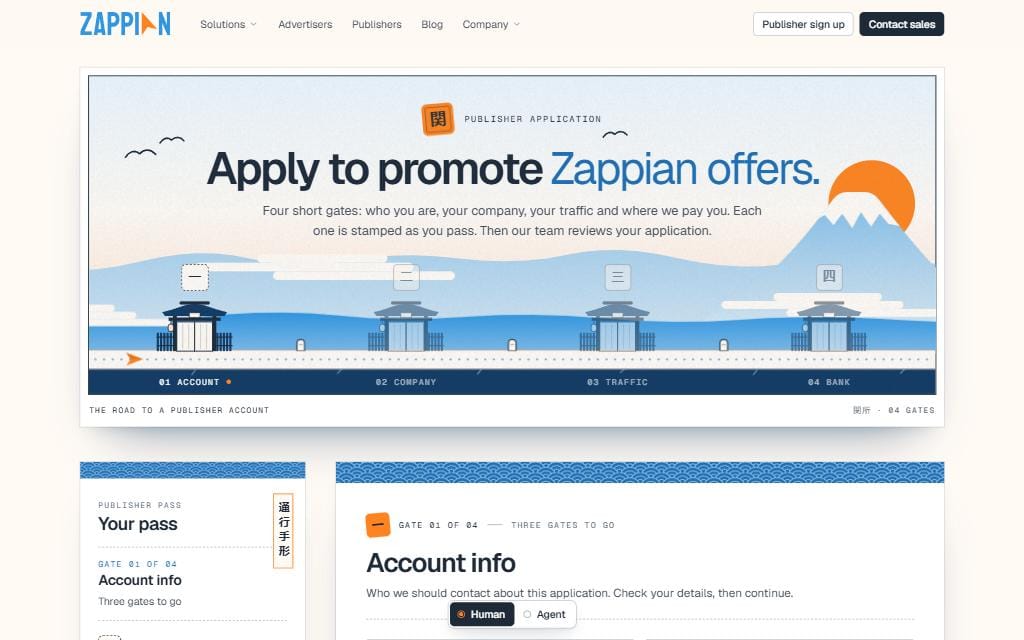
The top of the publisher sign-up page: a mountain road with four numbered gatehouses and the arrow at the first gate, with the first step of the form below.
Opening view

What the picture is

This is a sekisho, an old checkpoint on a highway. A road runs through blue mountains under a pale sun. Four roofed gatehouses stand along it, with stone milestones between them. A small orange arrow, the logo's own mark, is the traveller. The traveller is the publisher applying. Each gate is one part of the application. Passing all four ends with the application in the team's hands for review.

The moment

Each time the visitor presses Continue, the gate they leave is stamped. An orange seal presses down on the gate on the road and on the pass. The gate doors swing open. The arrow hops three times and walks on to the next gate. The sun climbs a little at each stamp. After the last step all four gates are stamped. It says that progress is real and nothing is lost between steps. Typing and button presses trigger it. Scrolling does not.

Why this picture

An application is the page where visitors tend to give up. Breaking it into four named gates makes the length knowable, and stamping each gate gives a small reward. A checkpoint also fits what happens: a person reviews you before you can pass.

Details worth noticing

  • The form keeps the questions, rules and sending behaviour it always had. The page only draws the road around it.
  • A hidden live region tells screen reader users which gate they reached. Focus moves to the step title when a step changes.
  • On phones the pass becomes a slim bar that stays under the header with four small seals. The road print is cropped to keep the gates in view.
  • Missing answers are outlined after Continue is pressed, so every gap shows at once.
  • With reduced motion, the gates, the arrow and the sun change state without moving.
Read it section by section5 parts
Publisher sign-up, section by section
SectionWhat you seeWhat it means
Hero: "Apply to promote Zappian offers."The mountain road with four numbered gates, labelled Account, Company, Traffic and Bank. The arrow stands before the first gate.The whole application at a glance: four short gates.
Your pass (beside the form)A paper travel pass with one seal per gate, each marked "Ahead", "At this gate" or "Stamped". It also lists the papers needed at the current gate and a link to ask a question first.The pass is the publisher's progress, kept in view while they fill the form.
The paper (the form)A card with the gate's name and note, then the application form. Gate three asks which traffic sources apply, then shows a short page for each one, with a small tracker that counts the sources.Who you are, your company, your traffic and where we pay you.
Papers receivedAfter sending, the card reads "All four gates stamped" and the pass shows a completed mark.The application is with the team.
What happens after you apply.Three short numbered steps: we read your papers, we set you up, you earn on outcomes. Two links follow: the publisher programme and a question page.What the visitor can expect next.

Where the road stops

Lead programs and offers.

Pages for lenders who buy leads, then pages for publishers who promote an offer.

Print 08 of 21

Personal loan leads

The print
A ferry crossing a wide river
The story in one sentence
Each borrower is carried safely across the river, past every check, to the lender's landing.
Open the page: Personal loan leads
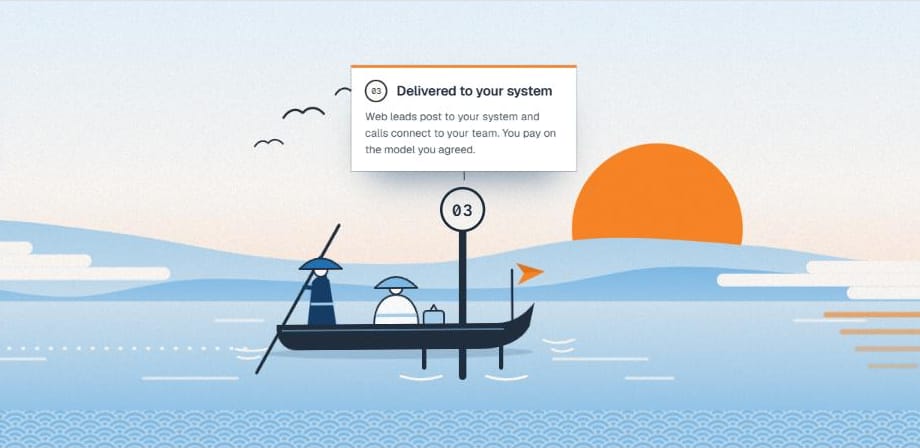
The crossing on the personal loan leads page: a boatman poles a ferry with a traveller aboard past a numbered post, under an orange sun.
The crossing

What the picture is

A river at dawn, drawn in blue tints on cream paper with one orange sun. A boatman with a pole waits in a flat ferry at the near bank. A traveller with a hat and a bundle steps aboard. On the far bank sits the lender's landing, half hidden in mist. The traveller is the borrower. The boatman is Zappian. The orange dart from the Zappian logo flies from the bow as the ferry's pennant, so the lead rides across with the borrower.

The moment

In "how it works" the ferry crosses the river as you scroll. On a desktop the section pins in place and scroll position moves the ferry. The camera follows it, the far hills move at half speed, and a dotted wake draws behind it. It slows into each post and waits while that step's card lights up. The message is that nothing skips a step.

Why this picture

Lenders buy leads that must travel from a person's first click to the lender's system. A crossing makes that handover visible: someone starts on one bank and ends on the other with help along the way. For the borrower, a ferry suggests getting from where they are to where they need to be, with no claim about outcomes.

Details worth noticing

  • On phones and tablets nothing is pinned. The ferry makes the crossing once on its own when the print comes into view, and the step cards sit in a plain list.
  • With reduced motion, or without scripts, the ferry simply rests moored at the lender's landing and every step is a plain card.
  • The last post is orange and the others are cream, so the destination stands out.
  • On small phones the hero print is drawn wider than the screen and centred on the ferry so the boat stays readable.
  • The ferry bobs, the sun and birds drift gently, and the mist bands slide. All of this stops under reduced motion.
Read it section by section7 parts
Personal loan leads, section by section
SectionWhat you seeWhat it means
Hero: "High-intent personal loan leads."The dawn print on one side and a short form on the other, headed "Let's get started."The lender sends their buy box (states, amounts, criteria, caps, payout model) and the crossing begins.
Why lenders choose Zappian for personal loan leads.A row of ticket stubs with a stamp, one reason per ticket.Each reason is a ticket for the crossing.
Five routes bring borrowers to you.A ferry chart seen from above: five piers on the near bank, dotted lines to one landing.Five ways of finding borrowers all end at the same place. As you read each route, its line lights and a small boat rides it.
Every borrower crosses to your landing.A long panorama with numbered posts and a moving ferry.The step-by-step path of a lead. Each post is one step.
What lenders ask before they buy.Open-and-close questions, the first one open.Practical answers at the landing.
Are you ready to get started?The same river at dusk, the ferry moored, a lantern lit, the traveller ashore.The crossing is complete.
Know About Personal LoansA notice board with a roof line and an example panel.The required disclosure, always shown, word for word.

Print 09 of 21

Payday loan leads

The print
One harbour through one day, from first light to moonrise
The story in one sentence
A payday is a day, so the page follows one day at a lender's harbour, hour by hour.
Open the page: Payday loan leads
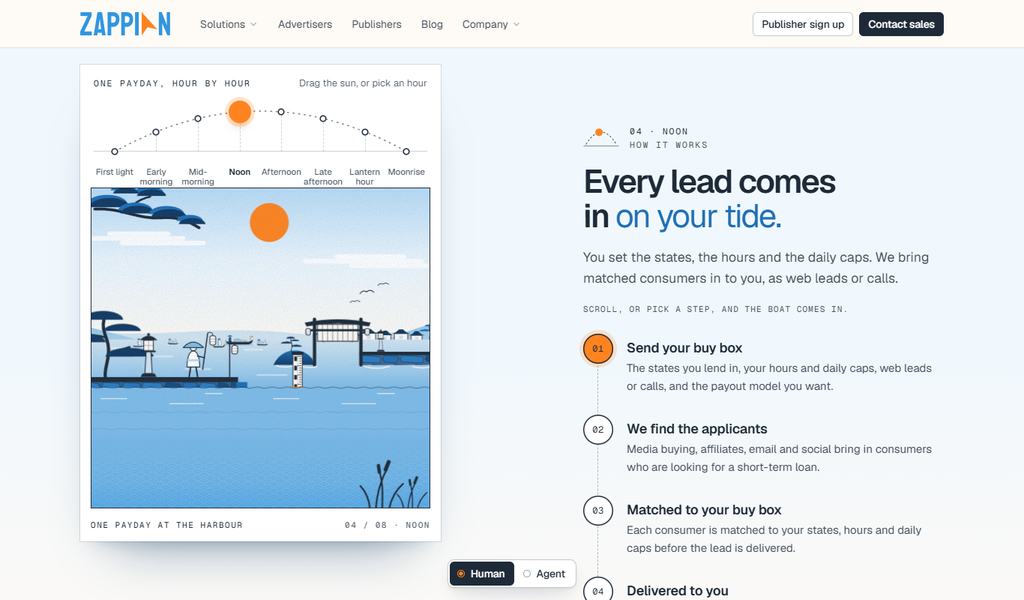
The payday loan leads page at noon: a harbour print with the sun high on its arc and the tide in, beside the steps of how it works.
Opening view

What the picture is

A small harbour in blue tints on cream paper, with one orange sun. A keeper with a lamp stands on a stone quay beside a tide staff. The quay is the lender. The boats under the wall are the channels. The boat that flies the orange dart from the Zappian logo is the lead. This one picture stays in view down the whole page and is lit again for each hour.

The moment

The arc above the print is the sun's path and the page's contents list. Drag the sun, tap an hour, or use the arrow keys. The page scrolls and the harbour is lit for that hour. The paper behind the words changes too, from dawn peach to evening blue.

Why this picture

The word payday holds a day inside it. A tide comes in on time, and a lender plans around it. One place seen through one day gives each idea its own hour.

Details worth noticing

  • On wide screens the print is the left page of an open book. On phones it is a band under the header.
  • The hours are chapter names only, not delivery times.
  • With reduced motion, or without scripts, every chapter is still there.
Read it section by section8 parts
Payday loan leads, section by section
SectionWhat you seeWhat it means
First light: Payday loan leads for lenders.Low water and a rising sun.What the page is for.
Early morning: Why payday lenders buy from us.The mist lifts and the tide comes in.What a lender gets.
Mid-morning: How we generate payday loan leads.The gate opens and the boats set out.Each boat is a channel.
Noon: Every lead comes in on your tide.High water. The boat with the dart comes in.How it works, step by step.
Afternoon: You focus on lending.The boat lies moored.The promise.
Late afternoon: How many a day can you work?A slider. The water rises against the staff.The lender sets a daily cap for the letter.
Lantern hour: What lenders ask us.The sun sets and the lamps are lit.Questions and answers.
Moonrise: Ready to get started?Evening blue and a full moon.The enquiry letter.

Print 10 of 21

Tax debt relief leads

The print
Rain clearing over a mountain pass
The story in one sentence
A hard, grey situation can ease step by step, and a lead is made along a clear road.
Open the page: Tax debt relief leads
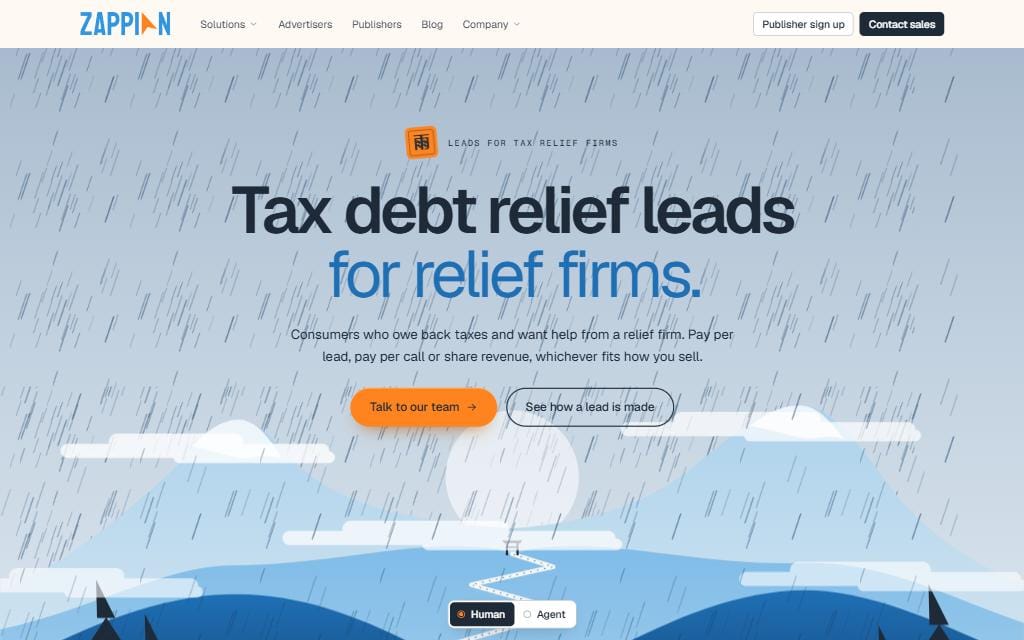
The top of the tax debt relief leads page: the headline under slanting rain, above a grey mountain pass with a winding road.
Opening view

What the picture is

One mountain pass, drawn twice. At the top of the page it sits under cloud and slanting rain, with the sun hidden behind a pale disc and snow on the peaks. A road of six switchbacks climbs to a gap in the ridge, where a torii (a Japanese gate) stands. At the end of the page the same pass is drawn in clear sky with an orange sun and birds. The climb is the path from a first ad to a lead in a relief firm's queue. The orange dart from the logo walks that road.

The moment

The weather changes as you scroll. A single value runs from rain to clear, and the sky blends from grey to light while the rain thins and lifts away. On desktop it follows your scroll position. In the six-step section, the dart is walked down the path by scroll, and each bend lights up as it is reached. The message is that the road is long but it leads somewhere clear.

Why this picture

Relief firms deal with people who are under pressure. Rain that clears is a gentle way to show a situation getting lighter, and a mountain road shows a series of small turns. The picture makes no claim about any outcome, and the page text says it does not advise anyone on tax debt.

Details worth noticing

  • The six step numbers are written in kanji (一 to 六) inside the bends of the path.
  • On phones and with reduced motion, nothing is scrubbed. Each section sets the sky as it reaches mid-screen, and the dart jumps to the latest step reached.
  • Under reduced motion the flying dart on the road is hidden and a still dart sits on the road instead.
  • Without scripts, the whole path is drawn and every step is shown, with a half-cleared sky.
  • The type stays calm and plain. Weather is the only large motion on the page.
Read it section by section8 parts
Tax debt relief leads, section by section
SectionWhat you seeWhat it means
Hero: "Tax debt relief leads for relief firms."The pass under rain, with rain drawn in front of the scene. A line reads "Scroll, the rain clears."The starting weather. The page tells you what will happen.
Quality first, then your appetite.Words on the grey sky.Zappian scopes the program to what the firm can handle.
A national market. Pick your states.A tile map of the states, each a small square.The firm's buy box decides which leads arrive. The map is a picture of a buy box, not a coverage list.
How a tax debt relief lead is made.The switchback path with six numbered bends and a dart that walks it.Six steps: Advertisement, Selection, Impression, Content, Inquiry, Lead.
Recent insights.Two links to articles.A way to read further.
Questions firms ask first.Questions, first one open.Plain answers on buying relief leads.
Get in touch.A checklist and a letter form.The firm sends its states, volume and payout model.
The sky is clear.The same pass with an orange sun.The weather has cleared.

Print 11 of 21

Merchant cash advance leads

The print
A merchant street at first light
The story in one sentence
A business owner who wants funding is a shop on the street, and a runner carries each lead down it to the funder's counter.
Open the page: Merchant cash advance leads
The merchant cash advance leads page: a runner carrying an orange pennant walks a quiet shop street, where numbered stops explain how it works.
Opening view

What the picture is

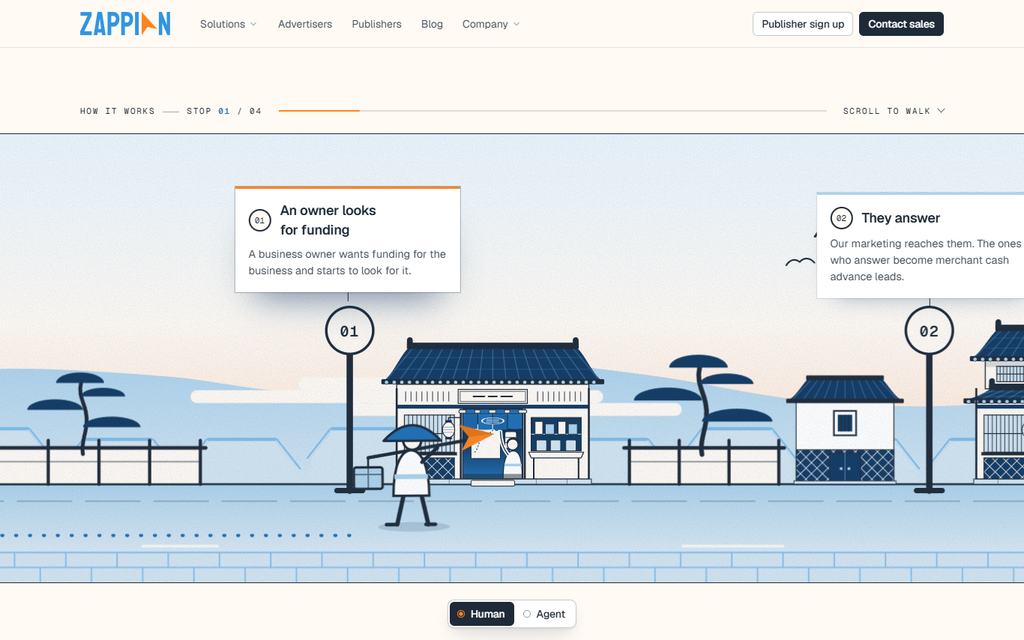
A quiet street in blue tints on cream paper with one orange sun. Shops with tiled roofs and indigo door curtains stand in a row. One owner lifts a curtain. A runner in a wide hat walks the road with a letter box on a pole. Each shop is a business owner. The runner is Zappian. The orange dart from the Zappian logo flies from the pole, so the lead travels with the runner.

The moment

In "how it works" the runner walks the street as you scroll. On a desktop the section pins in place. At each signpost the runner stops, the shop curtain lifts, and that step's card lights up. The message is that every lead starts with a real owner.

Why this picture

Funders buy leads about small businesses. A street of shops makes those owners visible. The picture says nothing about advances, costs or terms.

Details worth noticing

  • On phones nothing is pinned. The runner makes the walk once on its own.
  • With reduced motion, or without scripts, every curtain is already up.
  • The last signpost is orange, so the funder's counter stands out.
Read it section by section9 parts
Merchant cash advance leads, section by section
SectionWhat you seeWhat it means
Hero: "Aged merchant cash advance leads for funders."The street print and a short form.The funder says what they want.
It is about your appetite.Order tickets with a stamp.Each ticket is one line of an order.
How we generate MCA leads.A street plan from above, beside a list.Each shop is one way a lead is found.
From a shop curtain to your counter.A long street with numbered signposts.The steps from an owner to a lead the funder works.
Put your order together.One question at a time, and an order slip.The funder's own answers, added to the form by one button.
Recent insights.Tickets that link to articles.Further reading.
What funders ask before they buy.Open-and-close questions.Plain answers.
Business owners. Funders.Two names joined by a dotted line.The two sides of the street.
Tell us your appetite.The street at dusk, lanterns lit.The day's trade is done.

Print 12 of 21

Debt consolidation

The print
Streams joining one widening river
The story in one sentence
Many small streams run into one river, as many debts run into one payment, and the page draws that river down its own length.
Open the page: Debt consolidation
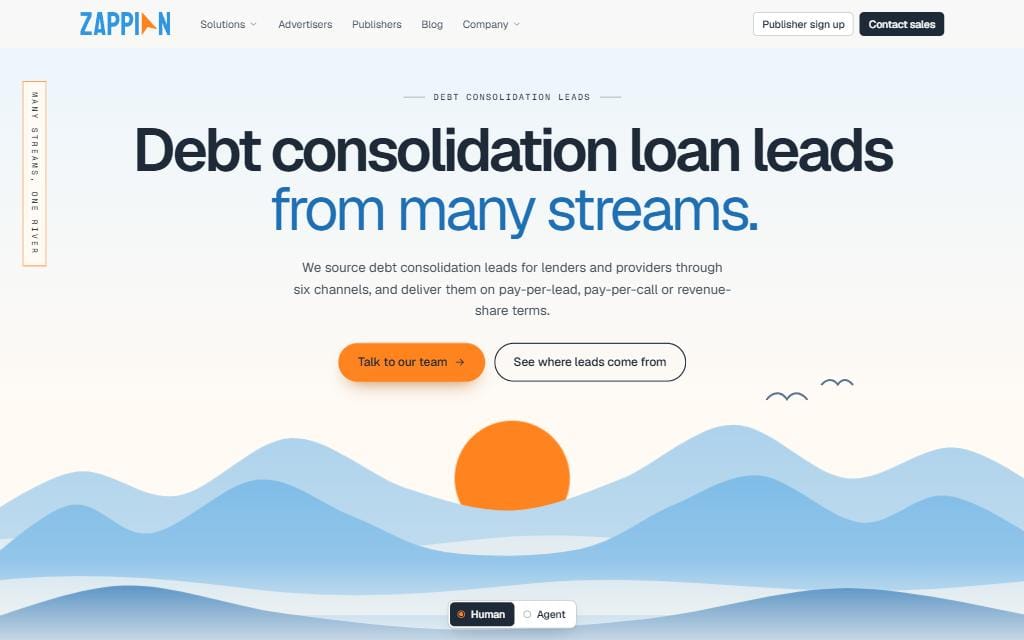
The top of the debt consolidation page: the headline “Debt consolidation loan leads from many streams.” above blue hills at dawn and an orange sun.
Opening view

What the picture is

Blue hills at dawn with an orange sun, and thin streams running down the slopes. From there, thin blue lines run down the margins of the whole page. At each section one line turns in and joins a central river, which gets wider after every join. At the bottom the river ends in a calm lake under an orange sun. Each section carries a stream number in kanji. The streams stand for the channels that supply leads. The river is the single place they all reach, the lender's buy box. It also echoes the page's subject, which is many debts becoming one payment.

The moment

As you scroll down, the lines draw themselves. The river head moves with the screen position, with a small paper dart riding its tip. The river thickens at each confluence. In the "why" section, the cards also travel sideways as you scroll down, with a thin progress bar. The message is that separate sources become one flow.

Why this picture

A consolidation page is about combining many things into one. A river made of streams shows that without any numbers. For a borrower who has several debts, one river is a calm way to picture one place to look at. The picture makes no claim about cost or results.

Details worth noticing

  • On phones the streams keep to the left edge and each line draws once when it comes into view. The cards become a swipeable strip.
  • With reduced motion every line is fully drawn at once and the cards wrap into a grid.
  • Without scripts the page is complete and the river layer is simply absent.
  • The river line is the brand blue with a pale blue edge, and the thin streams have a cream edge.
  • Stream numbers use kanji seals, 一 for the first and so on.
Read it section by section6 parts
Debt consolidation, section by section
SectionWhat you seeWhat it means
Hero: "Debt consolidation loan leads from many streams."The dawn hills with streams starting down the slopes. A small note reads "Many streams, one river."The source of the river.
Why Zappian, the first stream: "How we work with lenders."A row of cards that slides sideways, each with a small wave line.The terms a lender can set: pay per lead, pay per call, revenue share, and choice of channels.
Where leads come from, the second stream: "Six channels, one buy box."Six streams, each with an icon: media buying, email, SMS, push, content, social.Each channel is its own stream that runs to the same place.
The facts: "Consolidation and settlement, plainly."Four cards, the first with a diagram of several lines becoming one.Plain definitions. The diagram is captioned "Several debts" and "One payment".
Questions: "Frequently asked questions"Questions, first one open.Short answers.
Get started: "Bring the streams together."A lake and a letter form.The river arrives, and the lender sends their loan type, states and payout model.

Print 13 of 21

Personal loan offer

The print
Folding fans, opened leaf by leaf
The story in one sentence
An offer unfolds one clear part at a time, so an affiliate can see everything before they decide to join.
Open the page: Personal loan offer
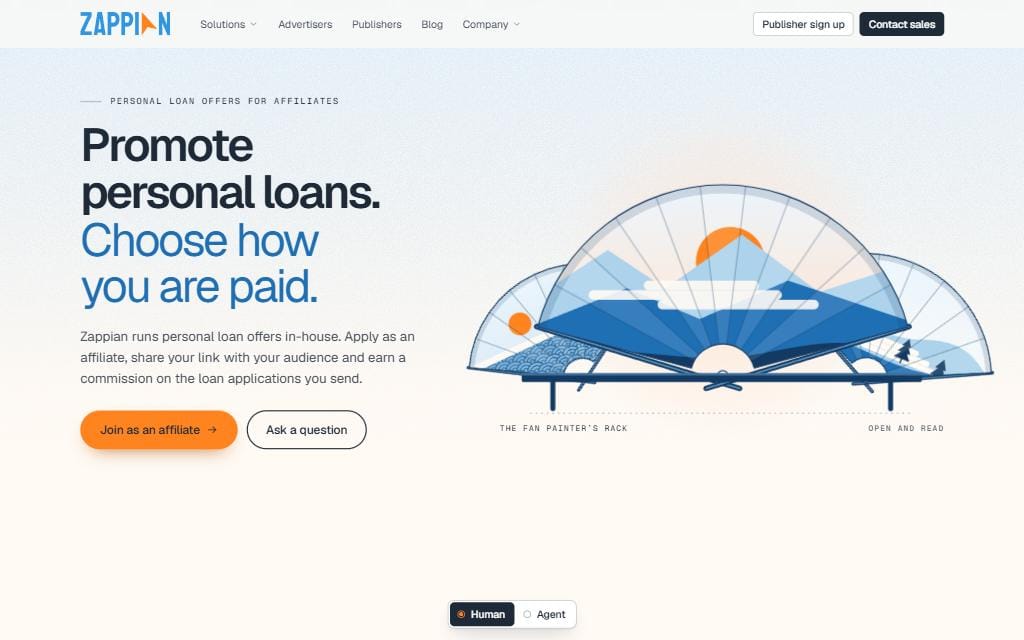
The top of the personal loan offer page: the headline beside a rack of three painted folding fans.
Opening view

What the picture is

Folding fans painted in blue tints on cream paper, each with one orange sun. The hero is a fan painter's rack with three fans, each painted with its own scene: sunrise over mountains, waves and pines. The large fan opens once on load. A fan is a natural way to show "many parts of one thing", because its leaves are separate yet joined at one point. Here the leaves are the parts of the offer a publisher gets. This page is for affiliates who promote the offer, so the picture speaks to them, not to lenders.

The moment

In the "what you get" section, the page pins on desktop and a single fan opens as you scroll. Each leaf swings out in turn from a shared pivot, glows with an orange rim, and its matching point on the right moves up and becomes clear. The message is that each part of the offer is separate, clear, and joined to the rest.

Why this picture

Affiliates ask first what they get, in what order, and under which rules. A fan opening leaf by leaf answers those one at a time. The painted fans on the step cards then walk them through joining. The picture makes no claim about earnings.

Details worth noticing

  • Below the desktop width, or with reduced motion, nothing is pinned. The fan is drawn open and the points are a plain list. On phones each point gets a small fan with its own leaf in orange.
  • The step cards slide sideways on desktop. Otherwise they are a normal swipe row with snap points.
  • The panel numbers and leaf numbers are kanji (一, 二, 三).
  • The hero fan opens once with a drawn-in line and a gentle sway. Both stop under reduced motion.
  • Every fan is built around one pivot, pointing up, so the same drawing can be reused at any size.
Read it section by section7 parts
Personal loan offer, section by section
SectionWhat you seeWhat it means
Hero: "Promote personal loans. Choose how you are paid."The fan painter's rack, captioned "The fan painter's rack" and "Open and read".An invitation to look at what is on offer.
What you get when you join.One large fan with numbered leaves, and a list of points beside it.Each leaf is one part of the program: commission on your model, reporting, your own referral link, and payments.
What a personal loan affiliate program is.Three panels numbered 一, 二, 三.Three ideas: you promote, a referral is tracked, you apply and follow the rules.
How the program works.A row of cards that slides sideways, each headed by a small fan with its own scene (dawn, waves, pines, mist, moon).Four steps and a card on terms. A closing note asks affiliates to be open with their audience.
Questions affiliates ask first.Numbered questions, first one open.Plain answers on starting and tracking.
Join the program, or ask us first.A checklist, a sign-up button and a letter form.The affiliate joins or asks a question.
Ready to get started?A sunrise fan opening above a horizon, in white on a dusk band.The fan is open and the offer is fully shown.

Print 14 of 21

Payday loan offer

The print
Paper lanterns lit along a river
The story in one sentence
Each part of the offer is a lantern on one walk, and the affiliate sees them light up one at a time.
Open the page: Payday loan offer
The top of the payday loan offer page: the headline above a string of orange paper lanterns over a river at dusk.
Opening view

What the picture is

A riverside walk at dusk, in blue tints with the last of the orange sun. The hero shows a string of paper lanterns over a river, a wooden arched bridge, hills, a bank with posts, and the lanterns' reflections broken into bars on the water. The closing picture shows the walk ending under one big moon-sun, with every lantern lit and one still hanging low. This page is for publishers who promote Zappian's own payday offer. Each lantern stands for one thing the publisher gets.

The moment

On desktop the "offer" section pins in place and the lanterns light one by one as you scroll. The lit lantern's text stays in focus under the string and the others fade. A small caret marks the current lantern, and a counter names the lantern and the total. On phones the lanterns hang down the left of a plain list and light as each one passes the middle of the screen. The message is that the offer is plain and comes in order.

Why this picture

Publishers need to see, quickly, what they would be promoting and what they would get. A lantern for each term makes the list easy to follow, and dusk makes each light easy to see. The picture is about the publisher's offer. It says nothing about loans, rates or borrowers.

Details worth noticing

  • Each lantern has a one-word kanji, such as 利 for payout and 道 for the link. They are decorative.
  • Under reduced motion, every lantern is lit at once and every text is visible. The sway and the glow stop.
  • Without scripts, every lantern is lit and every text is shown.
  • Lanterns are orange paper against a deep blue sky. Orange appears nowhere else in the scene.
Read it section by section7 parts
Payday loan offer, section by section
SectionWhat you seeWhat it means
Hero: "Promote payday loan offers we run ourselves."The dusk river with lanterns. A line reads "Scroll to light the lanterns."The walk begins.
One walk along the river, one lantern for each thing you get.A cord of lanterns, each unlit at first, with one text block in focus.Each lantern is a feature of the offer: payout models, offers Zappian owns and runs, your own referral link, account review.
What is a payday loan affiliate program?Plain paragraphs, with a boxed note headed "Before you promote".A short explanation of how an affiliate earns, plus a note marked by a seal.
Three steps to become a payday loan affiliate with Zappian.Three numbered stones across a dashed line, the middle one set lower.Sign up, get your link, earn on leads. They read like stepping stones.
Frequently asked questionsNumbered questions, first one open.Plain answers.
Let's make progress together.A letter form.The affiliate writes about their traffic and channels.
Ready to light your first lantern?The dusk scene, every lantern lit.The walk ends, and the publisher is invited to begin.

The house

The company.

Who we are, how we work together, what we publish and the rules we keep.

Print 15 of 21

About us

The print
A hand scroll unrolled across a table
The story in one sentence
The visitor reads the company like a scroll, one painted scene at a time, and sees what Zappian does and what it values before being invited to partner.
Open the page: About us
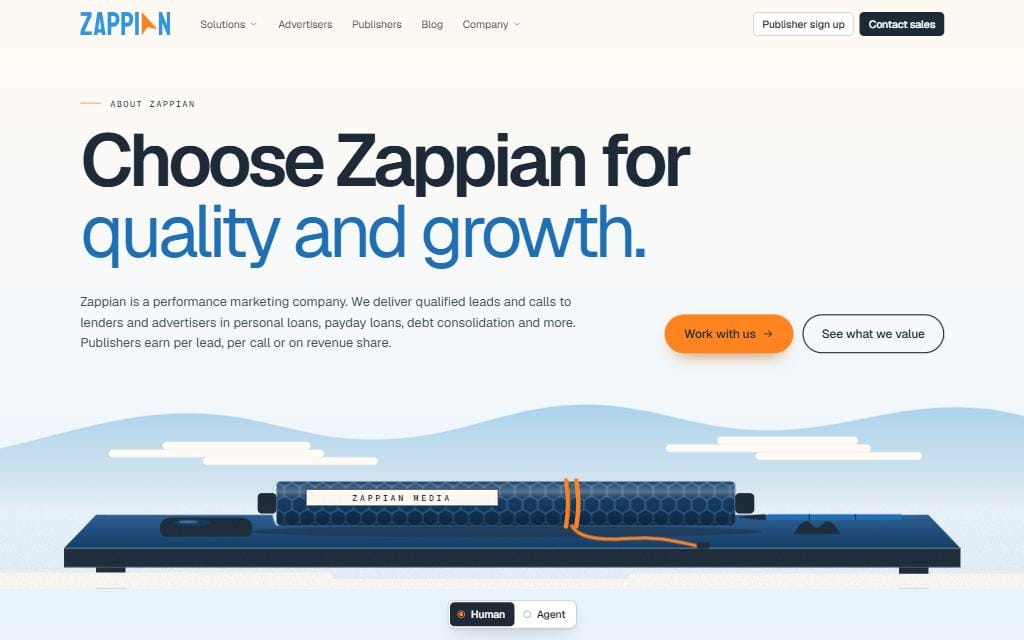
The top of the about page: the headline “Choose Zappian for quality and growth.” above a scroll tied with an orange cord on a low table.
Opening view

What the picture is

The page is built as an emakimono, a Japanese hand scroll that is read by unrolling it sideways. The top of the page shows the scroll tied shut on a low table, with an ink stone, a brush on its rest and a tiny paper title slip reading the company name. Everything below is a scene painted along that scroll: the work today, then the values. The scroll stands for the company itself, told in order and by hand.

The moment

On a wide screen the scroll section pins in place and scrolling drives it. The two rolls start together, tied with the orange cord, then part and open the paper. The paper then travels right to left while the left roll thickens and the right roll thins. A small map above tracks the scene number. It says the company is a story you read in order, and you set the pace.

Why this picture

An About page asks the visitor to understand who a company is. A scroll turns that into reading in sequence, with the work before the values. The closing doors give the reading a purpose: publishers and lenders each have their own way in.

Details worth noticing

  • Orange is kept for the cord, the sun, the paper dart and the seals. Everything else is blue tints on cream with navy ink.
  • Each value scene carries small slow movement: boats bob, geese drift, the dart floats.
  • On phones, and with reduced motion, the scroll does not unroll. It hangs on the wall with every scene stacked and visible.
  • Hovering a door slides its shoji open. On touch screens the shoji rest partly open.
  • With reduced motion, the ensō and the screen panels appear already drawn.
Read it section by section6 parts
About us, section by section
SectionWhat you seeWhat it means
Hero: "Choose Zappian for quality and growth."The tied scroll on the table. The cover is woven in a tortoiseshell pattern, with an orange cord.Here is the company, closed, waiting to be read.
"Welcome to the world of quality leads."A folding screen of four panels. Each has a round crest (a peak, two rings, ripples, a wheel) for Quality, Support, Transparency and Technology. One landscape of pines, mist and a sun runs across all four.What a partner receives, shown as one continuous painted screen.
"Conscious in how we work."A large ensō, a circle drawn in one brush stroke, with the word "Conscious" and an orange seal. The company's vision statement sits beside it in its own words, with its three aims named underneath.The company's vision, as a single deliberate gesture.
"What we do, and what we value."The pinned scroll. Scenes of six boats (the channels) and three market stalls (the pay models), then five values: a summit, water, geese, a wave with a paper dart, a rope bridge.Work first, then the five values, painted in order.
"Partner with us and grow your business."Two doors with sliding paper screens (shoji). One shows boats for publishers, one shows stalls for lenders and advertisers.Pick your side of the market and step through.
"Let's make progress happen together."The enquiry form drawn as a letter, with a small roll on its right edge.The scroll ends in a message back to us.

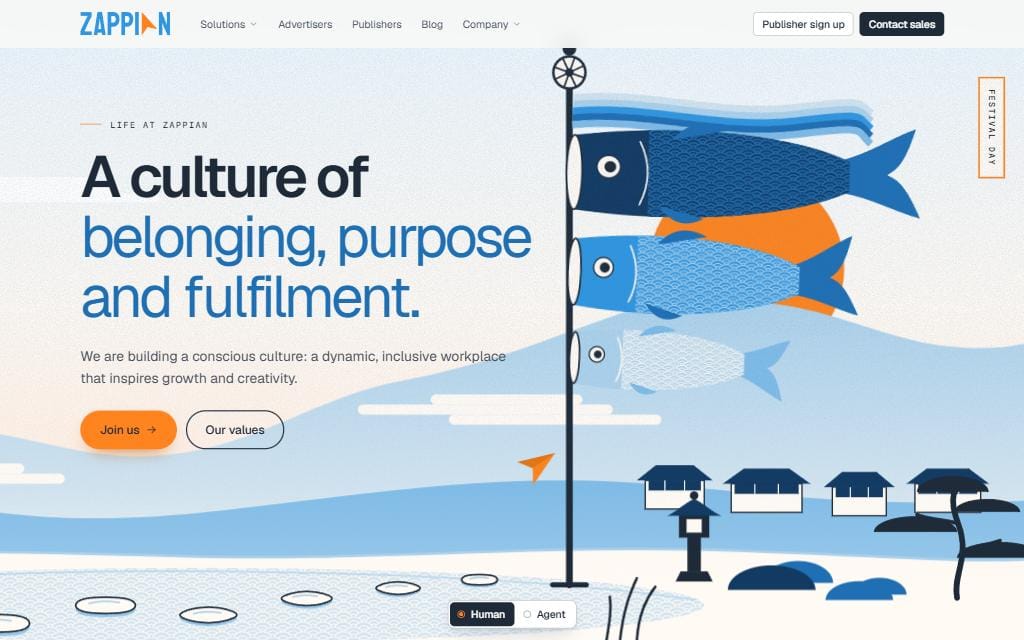
Print 16 of 21

Zappian culture

The print
A festival day with carp streamers
The story in one sentence
Working here feels like a festival day: shared, a little proud, and open to new people.
Open the page: Zappian culture
The top of the culture page: the headline beside carp streamers flying from a pole in front of an orange sun, with stepping stones across a pond.
Opening view

What the picture is

The page is drawn as one matsuri, a Japanese festival. Koinobori (carp-shaped streamers flown on a pole) fly in front of an orange sun, with stepping stones across a garden pond. Striped festival curtains, a tall banner, small stalls with noren (shop curtains) and a roofed notice board follow down the page. The festival stands for the team's shared life, and the carp stand for what it values.

The moment

The five streamers hang limp on the rope. As the visitor scrolls the line up the screen, the wind fills them one by one, and scrolling back lets them sag again. Tapping or focusing a streamer opens its value in the card below. It says each value is something that catches the wind, not a slogan.

Why this picture

A culture page needs to show warmth without stock photos. A festival gives it crowds, colour and ritual, and the stepping stones lead naturally to hiring. The audience is people thinking about joining.

Details worth noticing

  • Orange is kept for the sun, the dart and the seals. The streamers and scale patterns are blue.
  • The stall noren sway slightly on hover.
  • Photos are tilted by small amounts so the board looks pinned by hand.
  • Streamers can be reached by arrow keys. Without scripts every value is shown in full.
  • With reduced motion the streamers fly from the start and nothing moves.
  • On phones the streamers tilt less and the board photos shrink.
Read it section by section9 parts
Zappian culture, section by section
SectionWhat you seeWhat it means
"A culture of belonging, purpose and fulfilment."The festival print: streamers on a tall pole, orange sun, pond, a corner label "Festival day".The mood of the place, up front.
"Built to grow with a changing market."The CEO's note beside a portrait hung under a nobori, a tall festival banner.A word from the head of the company.
"True to the core."A striped festival curtain (maku) across the top, then a pulled quote and short text.The vision, hung like the curtain at the festival gate.
"Five values, one line."A rope across a river with five carp streamers. Each carries one kanji. Under it, one value card with a photo.The five values, flown in a row.
"Wellbeing is part of the work."Three little stalls under indigo noren, one per program.Care for people, offered like stalls at a fair.
"Giving back, close to home."A pinned photo ringed by raked-sand circles.The company's charity work, spreading outward.
"The wall of good days."A roofed notice board with five labelled groups of tilted, pinned photos, some with tape.Real moments, kept on a wall.
"Five stepping stones to your first day."Five stones across a pond, with the orange paper dart resting on the last. Each hiring step sits beside a stone.Joining is a short, clear walk.
"Find your place on the team."The garden gate standing open, stones leading to it, the dart flying through.An invitation to come in.

Print 17 of 21

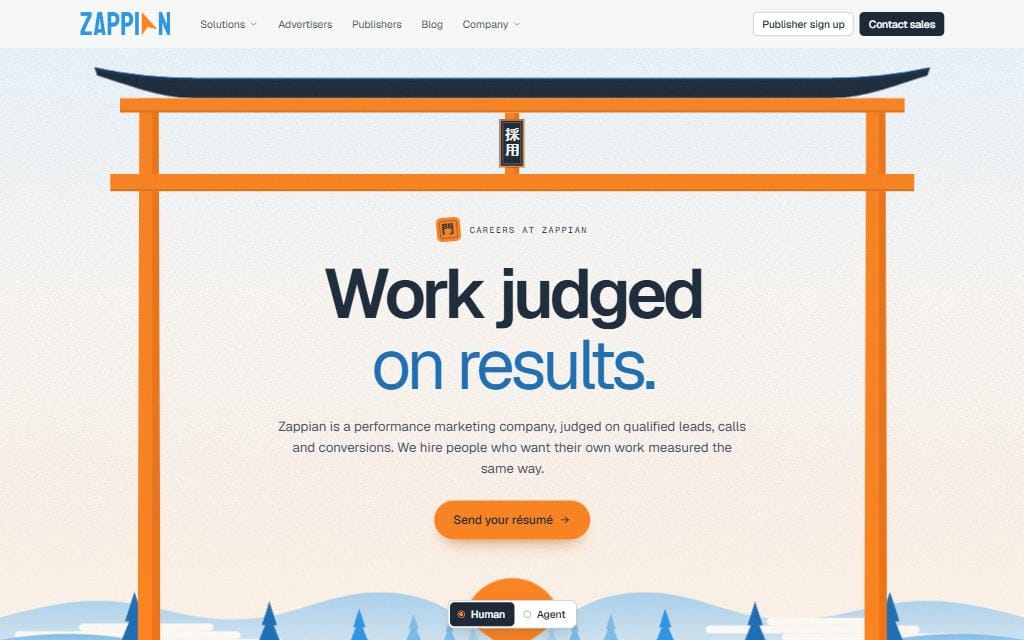
Careers

The print
A shrine gate, plaques, a path
The story in one sentence
Walk through the gate, pick a role from the rack, and your choice follows you to the form.
Open the page: Careers
The top of the careers page: an orange shrine gate framing the headline “Work judged on results.”
Opening view

What the picture is

The page is an approach to a Shinto shrine. A torii (the orange gate that marks the entrance to a shrine) frames the headline. Through it a stone path runs between cedars and stone lanterns toward a low sun. Past the gate hangs a rack of ema, the small wooden plaques where visitors write a wish. Each plaque is one job. The form at the end is the plaque you write yourself.

The moment

Choose Apply on a plaque and a copy of it lifts off the rack. It swings and flies down the page while the page scrolls under it, then lands on the "Applying for" peg beside the form. The form fills in that role. Any scroll, touch or key press ends the flight at once. It says your choice is carried for you, not lost between steps.

Why this picture

A careers page has one job: get a candidate from "interested" to "applied". A shrine approach is a walk with a clear start, middle and end. The plaque is a good stand-in for a job post because it is small, readable and meant to be handed over.

Details worth noticing

  • Orange is kept for the gate, the sun, the cords and the seals. The wooden plaques and cedars sit in blue tints.
  • Plaques sway on hover. "Read the role" turns the plaque, and the description unrolls below it.
  • On wide screens a quiet path of stepping stones appears behind the content as you scroll, with the paper dart walking at its head.
  • The thank-you stamp is navy on orange, never white on orange.
  • With reduced motion the flight is replaced by a direct jump to the form, and the path is shown fully drawn and still.
  • The rack changes as roles open and close.
Read it section by section3 parts
Careers, section by section
SectionWhat you seeWhat it means
"Work judged on results." (hero)The gate built around the title, its beams curling up at the ends and a small sign on top reading "hiring" in kanji. Behind it the path, cedars, lanterns and sun, softened by mist.You are at the entrance. The company's standard is stated first.
"Every plaque is an open role." (or "No open roles right now.")A little-roofed rack with hanging plaques, each with a small print on top, a job title, location and experience. A "Show" filter appears when some roles are closed. Empty places are filled with faint plaques left by other visitors.Each job is a plaque you can read. If nothing is open, one plaque says "Write your own plaque."
"Tell us about you."A pegboard slot labelled "Applying for", a short list of points, and the application form on a wooden board with a wave print and sun. A stamped thank-you appears after sending.Where your plaque ends up, and where you add your own words.

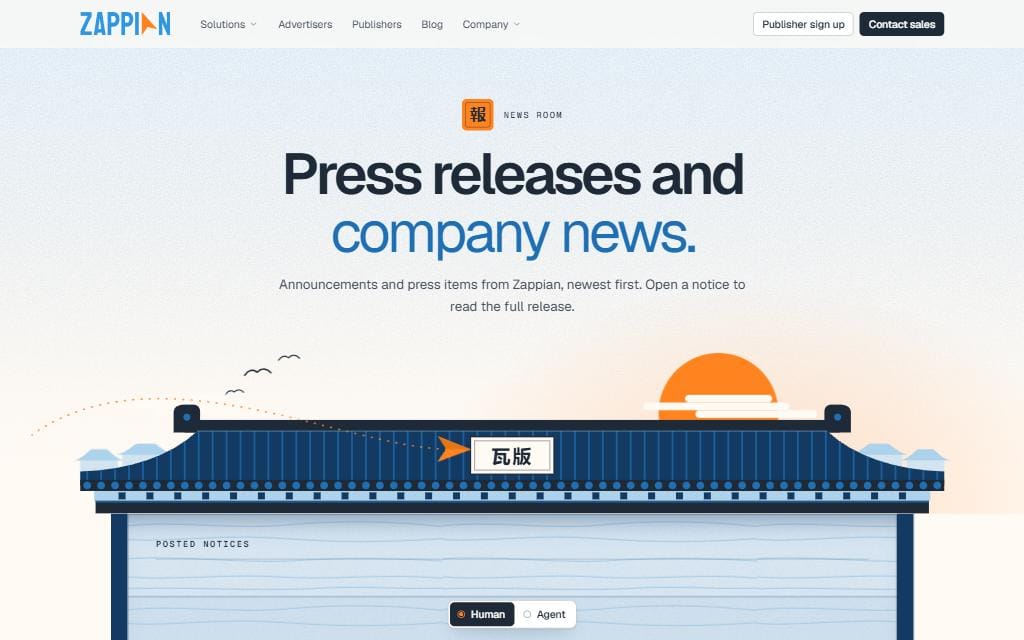
Print 18 of 21

News room

The print
A town notice board under a roof
The story in one sentence
News is posted in public, newest first, where anyone can walk up and read it.
Open the page: News room
The top of the news room page: the headline “Press releases and company news.” above the tiled roof of a notice board, with an orange sun behind it.
Opening view

What the picture is

The page is a kosatsu-ba, the roofed notice board of an old Japanese town, where printed news sheets called kawaraban were pinned up. The top shows the board's tiled indigo roof, with a paper plaque under the eave bearing the kanji for "kawaraban". An orange sun sits behind the roof and rooftops peek out on both sides. Below, each announcement is a printed sheet pinned to the board. The board stands for the company's open, public record of what it says.

The moment

Each sheet settles onto the board as it scrolls into view. It drops in with a soft shadow, and its two pins press in just after it lands. On load, the sun rises behind the roof and the dart flies in once along a dotted road to rest beside the plaque. Hovering a sheet lifts it a little. The motion says each notice is put up by hand, and then stays put.

Why this picture

A news room has one job: show what the company has said, in order. A town notice board is the oldest form of that. It is public, dated and not edited after posting. It suits an audience of press, partners and anyone checking the company out.

Details worth noticing

  • Orange is kept for the sun and the dart. Roof tiles, mist and photos stay in blue tints.
  • Photos on sheets are decorative, since each headline already says what the photo shows.
  • Only the date is printed on a sheet. No place name is shown.
  • On narrower screens the grid collapses to a single column of sheets.
  • With reduced motion, and without scripts, the sheets are simply there and the hover lift is off.
Read it section by section5 parts
News room, section by section
SectionWhat you seeWhat it means
"Press releases and company news." (hero)A small seal, the headline, a short intro and the roof print. The roof has a sun, mist bands, birds and the orange paper dart beside the plaque.You have arrived at the board.
"Posted notices"A wooden board. The newest notice is the largest sheet on the left, marked "Latest". The next sheet sits beside it. Older sheets sit in rows of three below. Each sheet has a date line, a headline, an optional photo printed in blue ink, a short excerpt, a "Read the release" link and a number.Each announcement is a pinned broadsheet. Numbers count up from the oldest, so a higher number is newer.
Empty boardA sheet reading "Nothing is posted right now", with the dart flying over a pale sky.An honest empty state, not a broken page.
"Writing about Zappian?"A standing wooden tablet beside the sheets with a button to contact us.Where the press can write in.
"Between notices, read the blog."A closing band with two buttons, to the blog and to the culture page.Where to go when the board has been read.

Which notices appear depends on what editors post, so the sheets change over time.

Print 19 of 21

Blog

The print
A print seller's shop with shelves
The story in one sentence
Every article is a print you can pick up, and the shelves sort themselves by the topic you choose.
Open the page: Blog
Title plateA print seller's shop with shelves

What the picture is

The page is drawn as a woodblock print seller's shop. The newest article stands on an easel as a large framed print, in front of a round shop window with the sun just clearing the frame. Other articles are mounted like prints, with a white mat and a thin ink line, and catalogued, folded into a folio, or stood on blue wooden shelves. The articles are the stock, and the page is the shop that holds them.

The moment

Choose a topic, or type in the search line, and the shelves rearrange in place. Prints that stay on their plank slide along it to their new spot. Prints that leave slide off the end of the shelf and fade. New ones slide in from the right. The planks do not move, only the prints. It says the whole shop is reorganised around your question, not reloaded.

Why this picture

A blog index is a catalogue and the visitor needs to find one thing in many. A print shop already has the right habits: browse, pick up, put back. The audience is people researching affiliate and lead-generation topics, who want to scan quickly.

Details worth noticing

  • Orange is kept for the sun in the shop window and the paper dart. The planks are navy and blue.
  • Each article card has one tab stop. The title link stretches over the whole card, and only the topic and author links sit above it.
  • A hidden status line tells screen readers how many articles match.
  • Topics are real links, so the filter works without scripts, and a modifier-click opens a new tab.
  • With reduced motion the set simply changes with no sliding.
Read it section by section5 parts
Blog, section by section
SectionWhat you seeWhat it means
HeroThe "Zappian learning center" label, an intro, and the newest article on an easel with the caption "On the easel". Next to it are its tag, title, date, author, a read button and a "Browse by topic" button.The newest piece is shown first, like a window display.
"Fresh from the press."A numbered catalogue of the next articles, numbered on from the article on the easel, with a link to get new articles by email.The latest stock, in order.
"From the CEO's desk."An open folio of leaves, each an article with its mounted image.Hand-picked pieces from the head of the company.
"Browse the shelves."A bar of topic tags and a search line. Below, rows of prints standing on planks, with page numbers underneath. A notice for publishers sits below the shelves.Every article, sorted the way you ask.
"New articles, by email."An order slip with a tear-off stub, the email form, and the paper dart flying along a dotted path.The mailing list, drawn as a slip you post back.

Articles, topics, dates and authors change as editors publish. Sections for trending articles and the CEO's picks appear only when there are articles for them.

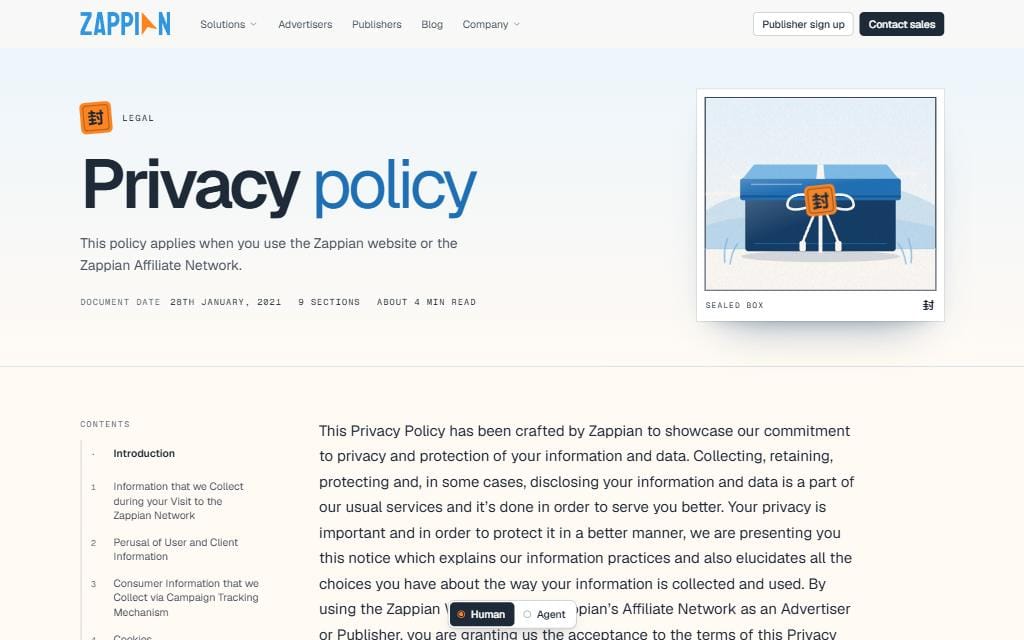
Print 20 of 21

Privacy policy

The print
A lacquered box sealed with cord
The story in one sentence
Your information is kept closed and handled with care, and the policy that says how is easy to read.
Open the page: Privacy policy
The top of the privacy policy page: the title beside a small print of a lacquered box tied with cord and closed with an orange seal.
Opening view

What the picture is

A small print of a lacquered letter box on a table, in front of far hills and mist. It is tied with a white cord in a bow, with two tassels. The knot is closed with an orange seal carrying the kanji for "seal". The box stands for private information kept shut. The rest of the page is plain reading, with no further art.

The moment

This page is quiet on purpose. The one visible effect is the seal on the box, which stamps down on load. While you read, the contents list marks the section you are in. A thin orange line under the header grows from left to right as you move through the text. The list is made of plain links, so it works without any script. It says you always know where you are in a long document.

Why this picture

A privacy policy is long, and most visitors scan it for one answer. The sealed box gives the topic a single clear image, and then the page gets out of the way. The contents list and progress line serve the actual job, which is finding the part you need.

Details worth noticing

  • The seal is the only orange in the picture. Everything else is blue on cream.
  • On phones the contents list folds into a bar under the header that names the current section and its place in the list. It opens into the full list on a tap.
  • With reduced motion the seal does not stamp, and the list's small transitions are off.
  • Printing hides the box, the contents list and the progress line, leaving only the text.
Read it section by section4 parts
Privacy policy, section by section
SectionWhat you seeWhat it means
"Privacy policy" (hero)A "Legal" label with a seal, the title, a one-line statement of who the policy covers, and three small facts: the document date, how many sections, and the minutes to read. Beside them is the sealed box with the caption "Sealed box".A calm start. The box sets the tone, and the facts tell you how long this will take.
IntroductionThe opening text of the policy, before the first numbered heading, when the policy has one.The policy's own opening, unchanged.
The numbered sectionsThe policy text, one section per heading, each with its number. A contents list sits beside it and follows you.The policy itself, word for word. The page adds no legal text of its own.
Back to topA small link at the end of the text, shown on phones and tablets.A way back to the contents.

The facts in the hero, the section list and the numbers are all read from the policy text itself, so they change when the policy changes.

Print 21 of 21

Terms of use

The print
A hanging scroll of numbered articles
The story in one sentence
The rules are set out plainly, in order, on a scroll you can read top to bottom.
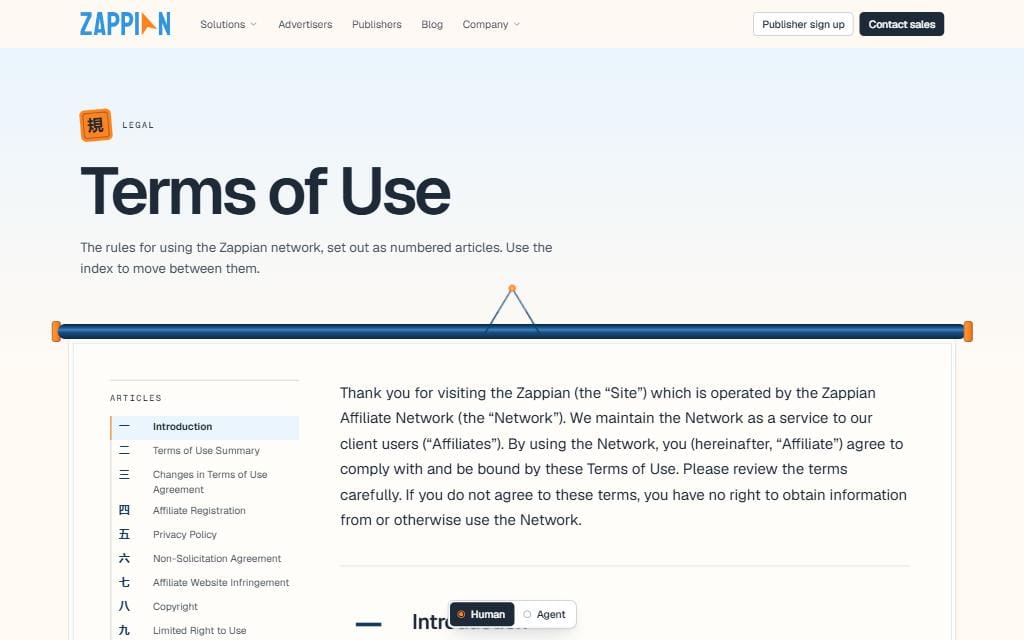
Open the page: Terms of use
The top of the terms of use page: the title above the top rod of a hanging scroll, with the index of numbered articles beside the opening text.
Opening view

What the picture is

The terms are drawn as a kakejiku, a hanging scroll. Two cords fall from an orange knot onto a rod at the top of the sheet, and a matching rod closes the bottom. Both rods are shaded like cylinders and have orange end knobs. The sheet between them holds the rules, each as a numbered article. The scroll stands for rules that are written down and fixed in place.

The moment

There is almost no moving part by design. The hero text rises in gently on load. While you scroll, the index marks the article in view and a thin line shows how far through you are. The page says these rules are calm, fixed and easy to follow, not something that performs.

Why this picture

A terms page is a document people check, not a story to enjoy. A hanging scroll is the Japanese form for a displayed text, so the picture fits without competing with the words. Numbered articles with kanji numerals suit an audience who needs to cite an article by its number and find it quickly.

Details worth noticing

  • Orange is kept for the knot, the rod knobs and the seal. The sheet is cream with navy text.
  • On phones the margin index folds into a one-line bar that names the article being read and opens on tap. Without scripts the full list is shown.
  • The kanji numerals run to ninety-nine, then fall back to ordinary digits.
  • Links to other sites open in a new tab.
  • With reduced motion the hero reveal is off.
Read it section by section7 parts
Terms of use, section by section
SectionWhat you seeWhat it means
HeroA "Legal" label with a seal for "rule", the title and a short lead saying the rules are set out as numbered articles.The page says what it is.
The scroll frameThe two cords and the knot, then the top rod.The scroll is hung and ready to read.
Index ("Articles")A list in the margin with a kanji numeral and title for each article. The article you are in is marked, and a thin bar shows your reading position.A way to jump between articles and see where you are.
"Before the articles"Any text that comes before the first article, if the terms have it.The terms' own opening, unchanged.
The articlesEach article has a large kanji numeral in the margin (for example the characters for one, two, three) with the word "Article" and its number beneath. The article's heading and text sit to the right.The rules, numbered in a way that feels like a classical document.
Back to topA link at the end of the sheet.A return to the start.
Bottom rodThe scroll's lower rod.The scroll ends.

The terms are shown word for word. The page adds only the labels around them.

The end of the road

Each print hangs on its own page.

Every picture is seen in full, and in motion, on the page it belongs to. Start at the homepage and follow the dart from dawn to dusk.